
Britain has never grown enough wood.
The island was substantially deforested by the medieval period, and what remained was oak — magnificent for ships and cathedral roofs, useless for the cheap softwood that ordinary building actually runs on. So from the seventeenth century onward, Britain imported. Deals from the Baltic, teak from Burma, mahogany from West Africa, white oak from America.
Which produces a curious consequence. When you buy most of your timber from other people, you frequently end up measuring it their way.
A Measure Designed to Be Wrong
Start with the strangest one, which is also British and also brilliant.
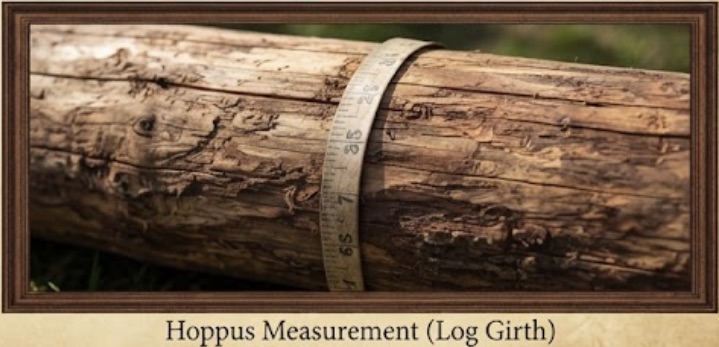
In 1736 a man named Edward Hoppus published Practical Measuring Made Easy, and gave the timber trade a method it could apply with a tape and no arithmetic to speak of. Measure the girth of the log at its middle. Divide by four. Square it. Multiply by the length.
The result is a hoppus foot, and here is the interesting part: it is wrong. It underestimates the true volume of the log by about 21.5 per cent, every single time, systematically.
That is the whole point.
Nobody uses a round log. You square it into a usable baulk, and the curved bits fall off as waste. The shortfall in Hoppus's formula corresponds closely to what is lost in that squaring — so the buyer pays for the timber he can actually use rather than for the tree that surrounded it.
Whether Hoppus intended that correspondence or merely noticed it was convenient is not entirely clear. Either way the trade adopted it for two and a half centuries, and tropical hardwoods are still traded in hoppus feet across parts of the Commonwealth today. A rough approximation from 1736 has outlasted the empire that spread it.
The Russian City in Your Timber Yard
Now the one that gives the game away entirely.
The standard measure of imported softwood in Britain was the Petrograd standard: 165 cubic feet of sawn deals.
Petrograd. As in St Petersburg. A unit named for a Russian city, governing the timber yards of every British port, for the straightforward reason that the timber came through St Petersburg and the Russians set the measure.
And look at how it is defined: 120 pieces measuring 12 feet by 11 inches by 1.5 inches. Not a round number of anything. That peculiar specificity is simply the dimensions in which Baltic deals were actually sawn — the unit describes a real stack of real planks, and the cubic footage is a consequence rather than a design.
A ghost in the name: St Petersburg was renamed Petrograd in 1914, then Leningrad in 1924, then back to St Petersburg in 1991. The timber measure kept the 1914 name throughout, which means British merchants spent the rest of the twentieth century invoicing in a unit named after a city that had not existed under that name since before most of them were born.
The Load That Changes Size
Then there is the load, which is fifty cubic feet of timber. Except when it is forty.
A load of squared timber is 50 cubic feet. A load of round timber is 40. Same unit, same name, two values.
This is not sloppiness. The load began as what a horse and cart could haul, and round logs cannot be stacked tightly — the gaps between them are air. So a cart filled with round timber holds less actual wood than the same cart filled with squared baulks.
Rather than measure every cargo, the trade agreed on two numbers and let the shape of the wood decide which applied. It is a measure of the cart rather than the contents, and once you see that, the apparent inconsistency turns into an entirely rational piece of design.
The same logic runs through the firewood measures. A cord is 128 cubic feet of stacked wood — four feet by four by eight — and it includes the air between the logs. That sounds like a swindle until you consider the alternative. Measuring the true volume of a heap of irregular billets would require water displacement or a great deal of trust. Stacking to a fixed frame is checkable by anyone with a tape and a suspicious disposition.
Britain mostly used the stack instead, at 108 cubic feet, which is twenty cubic feet smaller and caused predictable confusion in the transatlantic trade. A merchant quoting a price per unit was well advised to specify which unit he had in mind.
The Bundle, the Plank and the Barrel Stave
Three smaller units, each of which explains something.
The faggot was a bound bundle of brushwood, customarily three feet long and twenty-four inches in girth, sold by the hundred. Bakers heated bread ovens with them; brickmakers and lime burners consumed them by the thousand. Because sizes varied locally, manorial and municipal regulations frequently specified minimum dimensions to stop short bundles being passed off. The word survives in the culinary sense of a bound bundle of meat, and in the Roman fasces, which carry the same notion of strength through binding.
The deal began as a specific sawn section, typically nine inches wide by three thick, and then quietly became the name of the wood itself. Which is why Victorian furniture is described as being made of deal with no reference to dimensions at all. Anything narrower was a batten, anything thicker a baulk, and the distinctions mattered because duty and freight were charged on them.
And the stave, which is where every cask on this site begins. Oak split rather than sawn, following the grain so the finished vessel holds liquid without leaking, graded by the cask it suited: pipe staves for the largest, then hogshead, then barrel. Baltic staves supplied Britain for centuries before American white oak displaced them — and American white oak is still what your whisky matures in.
Measured by Other People
Put it together and a pattern emerges.
The Petrograd standard was set in Russia. The hoppus foot spread through colonial trade and stuck in countries that gained independence from Britain and kept the measure anyway. The stave trade followed the oak from the Baltic to America. Even the load, the most homely unit of the lot, was really a measure of a cart on an English road.
Most British measures were imposed from the centre: a king's arm, a statute, a brass bar in a vault. Timber was different. Britain needed the wood more than it needed the authority, so it largely accepted whatever measure came attached to the shipment.
Which is a reasonable summary of how trade actually works. The party that has the goods writes the units.