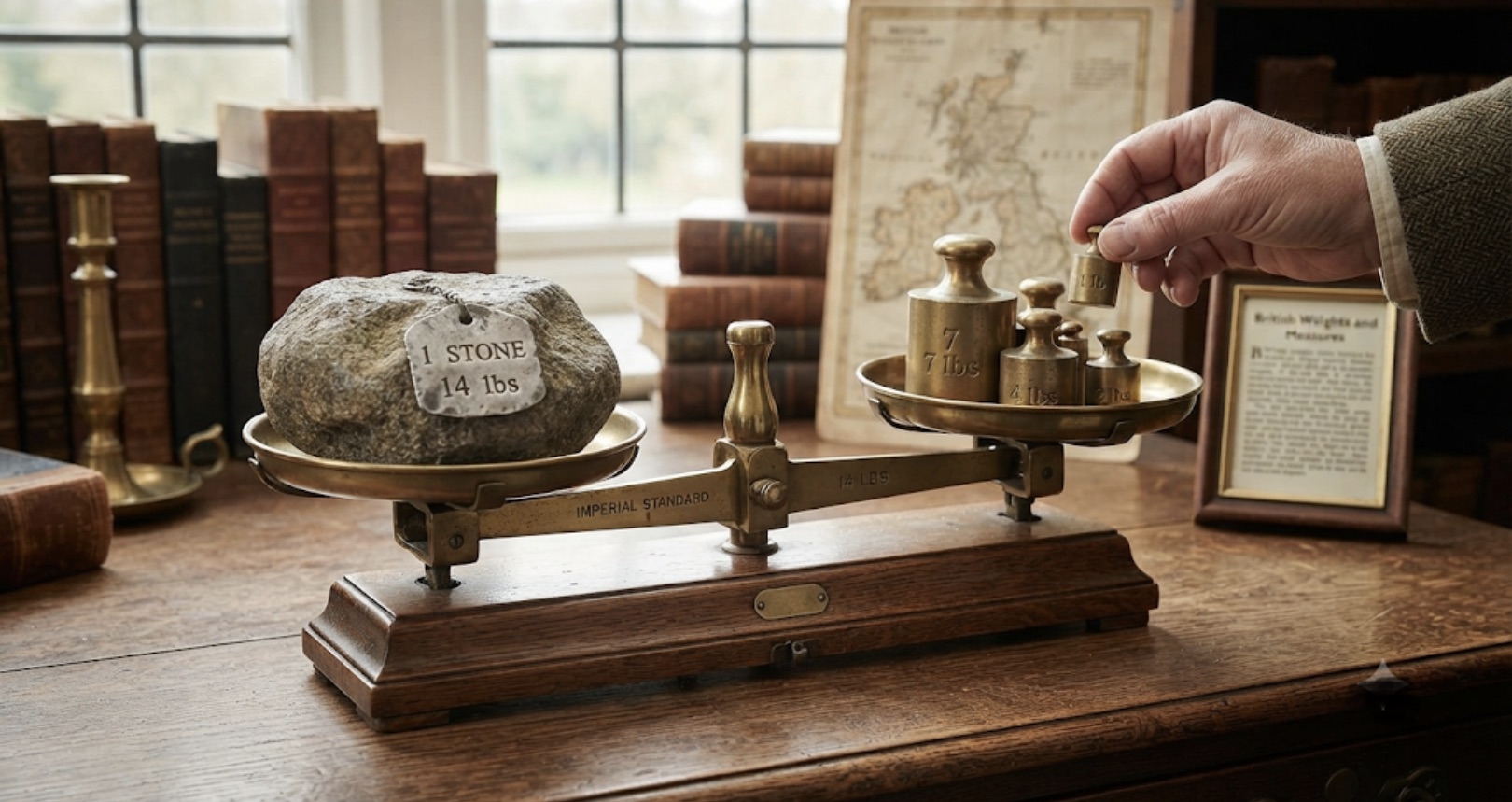
If you have ever been baffled by a British person announcing their body weight, you have likely encountered the "Stone." While most of the planet has comfortably settled into the logic of the kilogram—a unit as smooth and predictable as a French pastry—the British remain stubbornly attached to a unit that sounds like something you would throw at an intruder. Why, in the 21st century, do we still weigh ourselves in rocks?
The "Stone" of Contention
The "Stone" is essentially the ultimate "it depends" unit. Historically, in the Middle Ages, a stone was quite literally whatever size stone the local merchant had deemed correct. It varied wildly depending on whether you were buying wool, sugar, or lead. It wasn't until the 14th century that the Crown attempted to unify these weights, eventually settling on 14 pounds as the standard "Stone."
Why 14 pounds? Because it is a lovely, divisible number. It divides by 2, 7, and (sort of) 14. It is, in the eyes of a medieval marketplace, "mathematically convenient," provided you are not trying to calculate the weight of a rocket ship.
The Metric Revolution
Enter the kilogram. Born from the Enlightenment, the kilogram was an attempt to strip away the "human" messiness of history and replace it with pure, cold, hard science. Originally defined as the mass of one litre of water at its freezing point, it was the perfect, emotionless unit. It doesn't care about royal decrees, and it doesn't fluctuate based on whether you are buying wool or cheese. It just *is*.
British Logic: The British relationship with the kilogram is best described as "polite resistance." We use kilograms for our fruit, our vegetables, and our scientific endeavours—because we aren't savages—but the moment we step onto a bathroom scale, we revert to the Stone. It is the one place where we demand a measurement that feels substantial. You don't say you weigh "75 kilograms"—that sounds like a laboratory experiment. You say you weigh "11 stone 11," which sounds like a character from a Dickens novel.
The Divide: 1 Stone = 6.35 Kilograms
For those performing the mental gymnastics of conversion, the maths is unforgiving. One stone is exactly 6.35029 kilograms. This is why, when a Briton tries to lose "a stone," they are actually attempting to shed over 6 kilograms of mass—a much more daunting prospect when put in scientific terms.
The Verdict: Science vs. Soul
The kilogram is undoubtedly better for global trade, engineering, and not confusing international visitors. But the Stone remains because it is part of the British DNA. It connects the modern commuter to the medieval farmer. We have successfully adopted the metric system for everything that matters—like the speed of our trains and the price of our petrol—but we have kept the Stone as a final, stubborn reminder that we prefer our personal measurements to have a bit of historical heft. Even if that "heft" is effectively just a heavy rock.