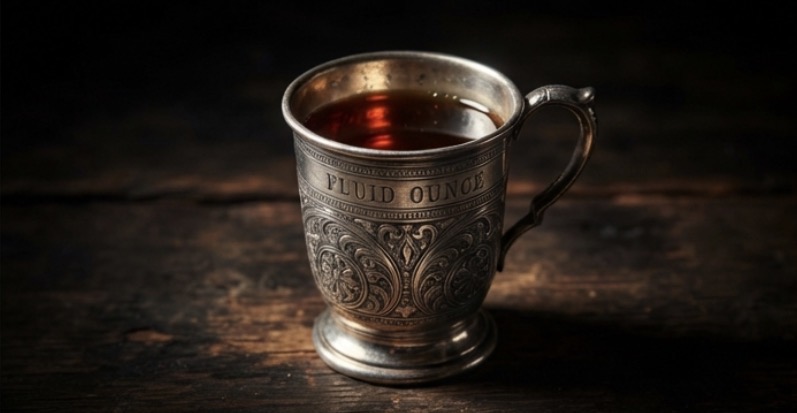
Measurement is often viewed as a dry, mechanical process, but the Fluid Ounce tells a more sophisticated story of scientific ambition. It was designed to solve a fundamental problem: how to harmonise the weight of a solid substance with the volume of a liquid one. It represents the moment when 19th-century science truly began to influence the kitchen and the pharmacy alike.
Origins and Early History
The fluid ounce began as a brilliant conceptual bridge between weight and volume. It was originally championed by apothecaries who desperately needed to convert dry powdered medicines into liquid tinctures safely. Historically, it was defined by the volume occupied by exactly one Avoirdupois ounce of wine or water, directly aligning the delicate scales of the chemist with the measuring jugs of the merchant.
The Fluid Ounce in the Victorian Era
With the creation of the Imperial system in 1824, the fluid ounce was mathematically perfected. The Victorians codified the Imperial Pint as containing exactly 20 fluid ounces (unlike the American system, which later split the pint into 16 ounces). This beautiful 20 fluid ounces per pint ratio meant that a fluid ounce of distilled water weighed exactly one Avoirdupois ounce of water under standard conditions—a masterstroke of 19th-century scientific organisation. This split created a hyper-precise grid for tracking tiny volumes of perfumes, fine oils, and dangerous chemical components.
Modern Usage and Legacy
While metric millilitres dominate modern scientific laboratories, the fluid ounce is still widely utilised and universally understood. It famously dictates the sizing of modern perfume bottles, luxury cosmetics, and international cocktail recipes, preserving the apothecary's precision in today's global marketplace. Every time you look at the back of a modern perfume bottle or a bottle of artisanal spirits and see "fl oz" listed, you are looking at a system built on the ingenious weight of a single drop of English rainwater.