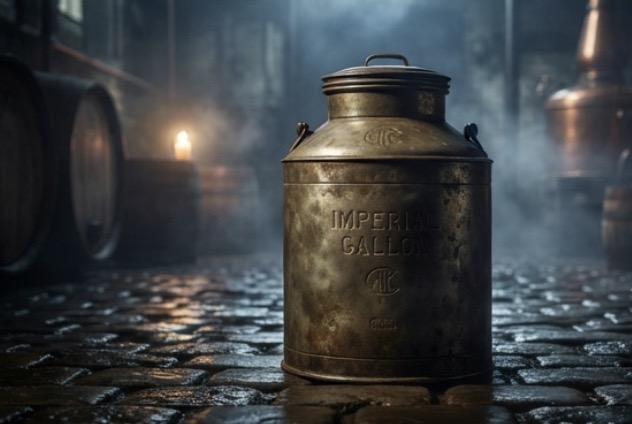
The gallon is the undisputed monarch of the capacity system, the ultimate standard from which all fractions—pints, quarts, gills, and ounces—must legally flow. Yet, the road to creating the single Imperial Gallon we know today was a battlefield of economic warfare, royal decrees, and tax loopholes.
Before the 19th century, England was plagued by three entirely separate, competing gallons. First came the wine gallon of 231 cubic inches, fixed by statute under Queen Anne in 1707 and used for imported wine and spirits. Then the ale gallon of 282 cubic inches, a Tudor standard for domestic malt liquor. Finally the corn gallon, larger again at 268.8 cubic inches, used strictly for dry grain and descended from the Winchester standards held since the Saxon period. Because the three did not agree, excise collectors and international merchants spent the better part of two centuries arguing over which vessel applied to a given cargo.
The Gallon in the Victorian Era
The landmark 1824 Imperial reform decisively swept away these competing standards. The newly minted Imperial Gallon was given a brilliant, unifying scientific definition: the exact volume of 10 pounds of distilled water at 62°F. This elegant definition permanently anchored the gallon to both the weight of water and ambient temperature, creating a rock-solid foundation for the massive global British trade that fuelled the empire. This new "Imperial Monarch" became the bedrock of global British trade, dictating the flow of fuel, wine, and industrial chemicals across an empire that spanned the globe. It stands as a monument to Britain's obsession with turning market chaos into mathematical law.
Modern Usage and Legacy
Today, the Imperial Gallon is still legally defined by its relationship to water. While petrol is overwhelmingly sold by the litre in the UK, the gallon remains a powerful cultural reference point for fuel efficiency (miles per gallon) and lives on as a cornerstone measurement in the United States and global aviation fuel tracking.