The Degrees of Difference: A History of Celsius, Fahrenheit, and the Transatlantic Temp War
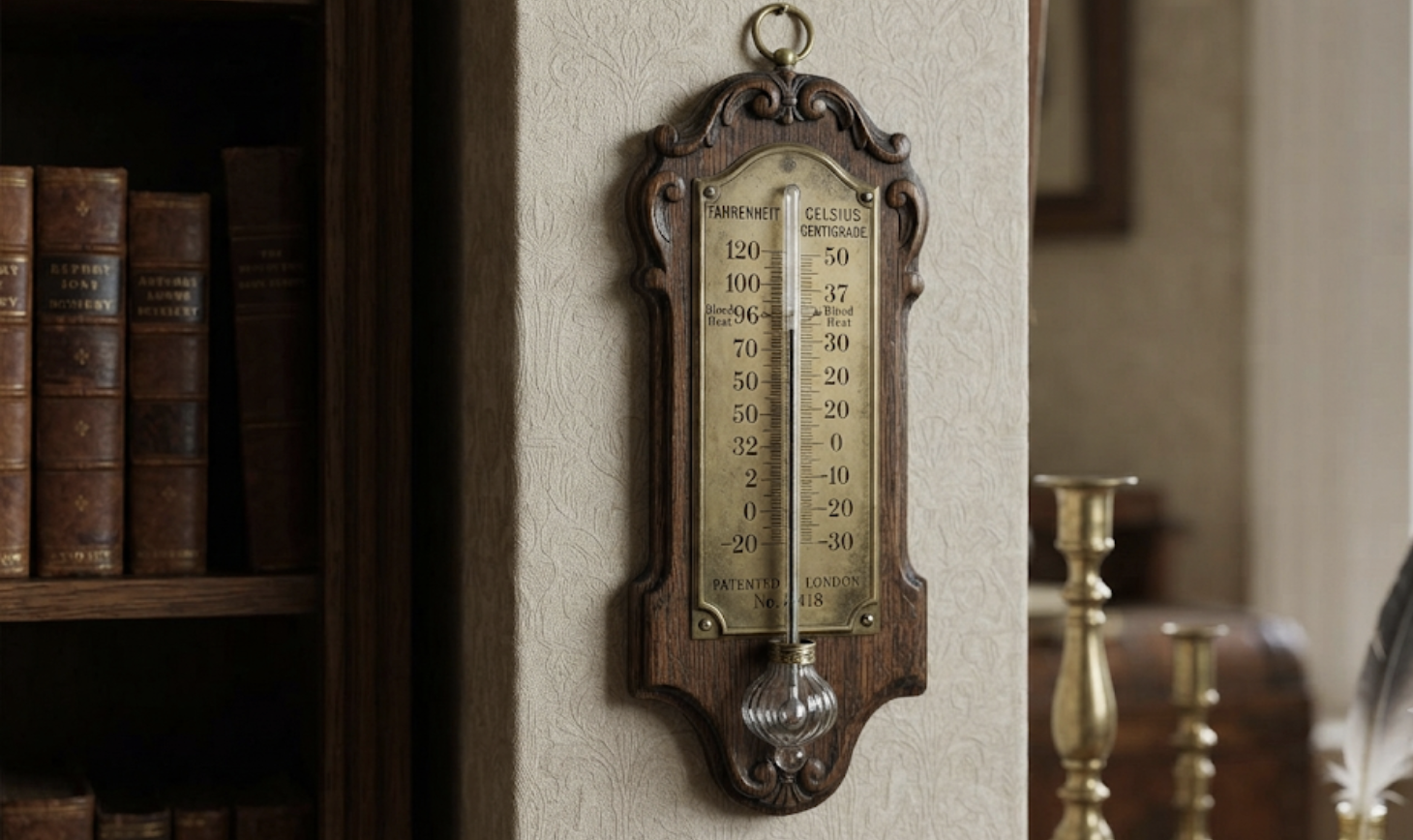
Temperature is one of the most immediate measurements we interact with every day. It dictates our clothing, our travel plans, and our comfort. Yet, the numbers we see on a weather report are not universal truths; they are the result of centuries of scientific rivalry, royal patronage, and political compromise. The great transatlantic divide between the United States and the United Kingdom—where one clings to Fahrenheit and the other uses a confusing hybrid of Celsius for air and Fahrenheit for miles—is a testament to this complicated history.
The Icy Origins of Fahrenheit
The story begins in the early 18th century with a Polish-born Dutch physicist named Daniel Gabriel Fahrenheit. Before his intervention, thermometers existed, but they lacked a standardised scale. Some were based on the body temperature of a healthy person, while others used the "extreme cold" of a cellar in winter.
Fahrenheit sought precision. In 1724, he established the scale that bears his name. Crucially, he didn't base his 0° point on pure melting ice; he used the temperature of a solution of brine, ice, and ammonium chloride—the coldest temperature he could reliably reproduce in his laboratory. This allowed him to avoid negative numbers in his daily work. He set the 100° mark near the temperature of the human body (though he initially aimed for the blood temperature of a cow). On this scale, pure water freezes at 32° and boils at 212°.
Where Fahrenheit Got the Idea
Fahrenheit did not arrive at his brine mixture unaided. In 1708 he travelled to Copenhagen to meet the Danish astronomer Ole Rømer, who had devised his own numbered scale seven years earlier and had solved precisely the problem Fahrenheit was wrestling with.
Rømer had also chosen a brine freezing mixture for his zero, for the same reason: it was the coldest temperature he could reliably reproduce in a laboratory, and starting there kept everyday readings out of negative numbers. He set body temperature near 22.5 and the boiling point of water at 60. Fahrenheit saw the method, went home, and multiplied it by four. That is very nearly the whole relationship between the two scales, and it explains the single most-asked question about Fahrenheit: why zero sits at no obviously meaningful point. It is not arbitrary. It is Rømer's brine, inherited.
The Scales That Lost
Rømer was not alone. The early eighteenth century was full of competing attempts to put reproducible numbers to heat, and two others deserve mention because British writers of the period used them constantly.
Isaac Newton, working around 1700, described a scale in an anonymously published paper of 1701. He used linseed oil rather than mercury because it expanded more readily, set freezing water at zero, and put boiling water at 33. His intermediate reference points are a fair summary of what an early scientist had to hand: melting wax, glowing coals, and the heat of the human body.
René Antoine Ferchault de Réaumur went further in 1730, building his scale around a dilute alcohol thermometer and dividing the range between freezing and boiling water into eighty parts. Eighty is a genuinely useful number for brewing, dairying and distilling, all of which care about a narrow band of temperatures, and Réaumur's scale dominated continental Europe for the better part of two centuries. British scientific and industrial writing of the period routinely quotes Réaumur figures alongside Fahrenheit, and Russian literature was still using it well into the twentieth century. If you have ever read a nineteenth-century European novel and found a temperature that made no sense in either familiar scale, this is probably why.
Celsius and the "Decimal Fix"
Just two decades later, in 1742, the Swedish astronomer Anders Celsius proposed a counter-argument. He found Fahrenheit's scale arbitrary and sought one rooted in nature. Celsius proposed a scale where 0° was the boiling point of water and 100° was its freezing point.
It was, to modern eyes, upside down. The scale we use today—0° for freezing and 100° for boiling—was actually proposed a year later by the Frenchman Jean Pierre Christin and, independently, by the Swedish botanist Carolus Linnaeus. They inverted Celsius's scale to make it more intuitive. For a time, it was known as the "Centigrade" scale (from the Latin for "hundred steps"), but in 1948, international scientific bodies officially renamed it "Celsius" in honour of Anders, cementing it as the standard for the metric world.
The Scientific Stoic: Kelvin
While weather reports concern themselves with Celsius and Fahrenheit, science needed a scale that didn't just measure relative heat, but the fundamental energy of a system. Enter Lord Kelvin.
In the mid-19th century, the British physicist William Thomson (later Lord Kelvin) developed the Thermodynamic Scale. It uses the same increments as the Celsius scale, but its zero point is not the freezing of water; it is "absolute zero" (-273.15°C), the theoretical point at which all atomic and molecular motion ceases. The Kelvin scale (it is never measured in "degrees Kelvin"—it is simply "Kelvin") is the bedrock of physics, from measuring cosmic background radiation to the efficiency of a car engine.
Kelvin's Imperial Twin
Kelvin solved the problem for scientists working in Celsius. It did nothing for the engineers, who worked in Fahrenheit and had no intention of stopping.
So in 1859 the Glasgow engineer William John Macquorn Rankine — a pioneer of thermodynamics alongside Kelvin and Clausius, and rather less famous than either — proposed the obvious counterpart. The Rankine scale begins at absolute zero, exactly as Kelvin does, but advances in Fahrenheit-sized degrees. Absolute zero is 0°R, which is −459.67°F. An engineer could apply the new thermodynamic laws without converting a single figure in his existing calculations.
It survives. Parts of American aerospace and combustion engineering still work in Rankine, which means that two absolute temperature scales, invented within a decade of each other by two Glasgow-connected physicists, remain in parallel use over a century and a half later. The difference between them is not science. It is which side of the metric argument you happened to be standing on.
The Transatlantic Temp War: US vs. UK
So how did we end up with the US using Fahrenheit and the UK using a hybrid system? It came down to the power of empire.
Fahrenheit’s scale was widely adopted across the British Empire in the 18th and 19th centuries. When the 13 American colonies declared independence, they took this Imperial system of measurement with them. Meanwhile, the newly minted metric system (and its Celsius scale) was taking over continental Europe, born from the intellectual rigour of the French Revolution.
The British Hybrid: The UK’s situation is unique. While they officially adopted the metric system (and Celsius for air temperature) to align with Europe in the 1970s, the conversion was never fully completed. Old habits die hard, and Britons still often use Fahrenheit when casually discussing a hot summer day or a warm oven, while simultaneously reporting the official forecast in Celsius.
The result is a fascinating cultural divide. An American tourist in London in January might see a report of "5°C" and have to mentally convert it to 41°F to understand the need for a coat. Conversely, a Briton visiting New York in July sees "95°F" and panics, requiring a mental step to 35°C to realise they're about to melt. We are all looking at the same sun, but we are speaking different languages of degrees.