Measuring the Empire: The Victorian Rod, Pole, and Perch
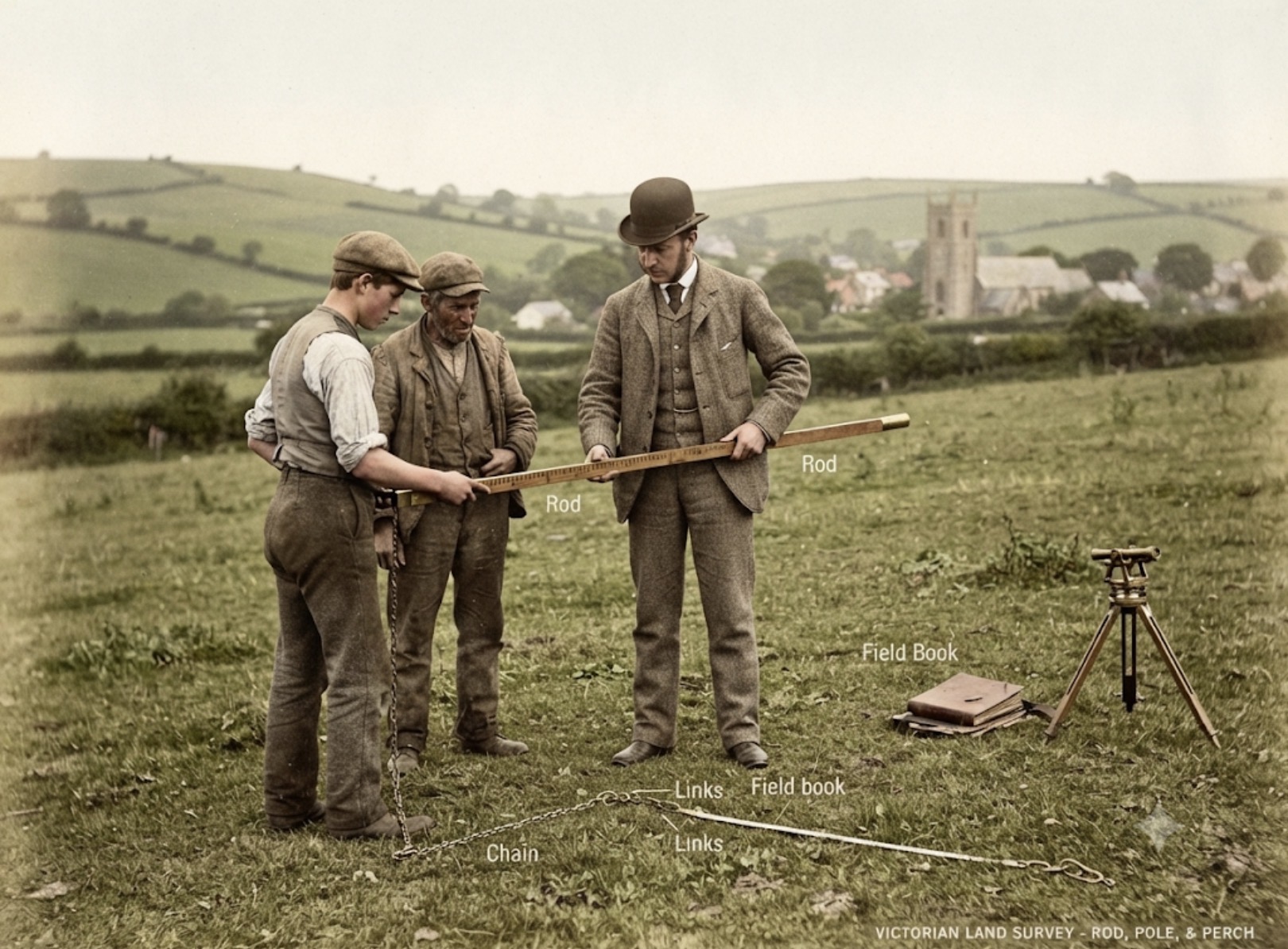
In the bustling landscape of Victorian Britain, the physical fabric of the country was measured by tools as humble as a wooden stick. For the Victorian surveyor, landowner, or farmer, the terms Rod, Pole, and Perch were not merely historical curiosities—they were essential, interchangeable units of linear and area measurement that held the weight of property law, agricultural output, and the vast expansion of the British Empire.
A Common Root in the Soil
While these three words sound distinct, they functioned as perfect synonyms during the 19th century, with each term officially representing a length of 5.5 yards (16.5 feet). Their reliance was rooted in their tactile nature: a "Pole" or "Rod" was traditionally a physical wooden staff used to guide ox teams, while the "Perch" derived from the Latin pertica (a surveyor's staff). By the Victorian era, these terms remained the common language for defining the size of a "rood" (a quarter of an acre) or the length of a furrow in a field.
Regional Nuance and Local Variation
Despite the Victorian drive for uniformity, the legacy of these units was deeply coloured by regional nuance. While the "Statute Perch" of 5.5 yards became the legal standard, historical variations persisted; for instance, the "Irish perch" traditionally measured 7 yards (21 feet), and certain agricultural districts utilised "customary rods" that fluctuated based on soil or crop type, reflecting a time when land was defined by its labour potential.
The Victorian Surveying Standard
As the Victorian age brought rapid industrialisation and railway expansion, these units became the backbone of land division. Surveyors utilised "Gunter’s Chain" (22 yards long, divided into 100 links), creating a precise mathematical relationship:
- 1 Pole = 25 Links
- 4 Poles = 1 Chain
This mathematical simplicity allowed engineers to scale measurements rapidly, calculating fields in "square perches" to be easily converted into acres for the legal record-keeping that fuelled the Victorian bureaucracy.
Legal Uniformity and the Decline of Tradition
By the time of Queen Victoria, the Weights and Measures Act worked to standardise these units, curbing the persistence of localised variations. These units eventually faded as metrication and precise, standardised tools rendered traditional, body-based measures obsolete. Today, they survive primarily as linguistic ghosts in old property deeds and the historical records of the land they once so reliably partitioned.