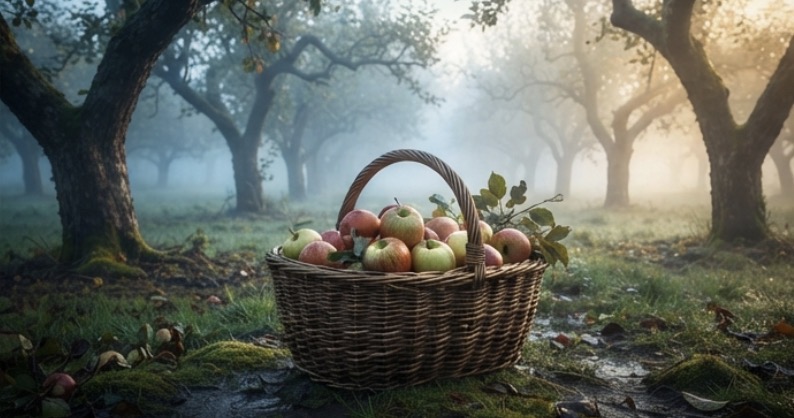
"Peter Piper picked a peck of pickled peppers..." This famous 19th-century tongue twister has kept the name of this ancient unit alive for generations, yet few modern readers know exactly how much volume Peter actually walked away with. There is something inherently rustic about the Peck. It evokes images of harvest festivals, autumn orchards, and the honest labour of the kitchen garden. Neither too large to be cumbersome nor too small to be negligible, the peck found its place as the "everyman’s measure" during the peak of British agricultural life.
Origins and Early History
Originating in the high Middle Ages, the peck was born out of pure agricultural practicality. It was the standard size of a hand-woven wicker basket that a labourer could comfortably strap around their waist or carry under one arm while moving down rows of apple orchards, berry patches, or hop fields. Because it was a physical basket before it was a mathematical abstraction, the peck varied wildly from county to county based on local custom. A "peck of peas" in Kent might look very different from a "peck of oats" in Yorkshire. This localised chaos meant that tithes paid to the local church or taxes paid to the lord's manor were a constant source of bickering.
The Peck in the Victorian Era
The 1824 Imperial reform brought the peck firmly into the modern era, officially standardising it as exactly two Imperial Gallons (or a quarter of a bushel). For the Victorians, the peck was the ideal household volume for purchasing bulk vegetables, neatly bridging the massive commercial scale of the merchant's bushel and the cook's daily needs.
Modern Usage and Legacy
Today, while supermarkets overwhelmingly sell produce by the kilogram, the peck refuses to disappear entirely. You can still easily spot it at modern farm stands and autumn apple orchards, where rustic hand-woven wicker baskets hold a perfect peck, keeping the seasonal agricultural traditions alive.