Two Gallons Enter, One Gallon Leaves: Why Your Pint Depended on Whether You Were Drinking Wine or Ale
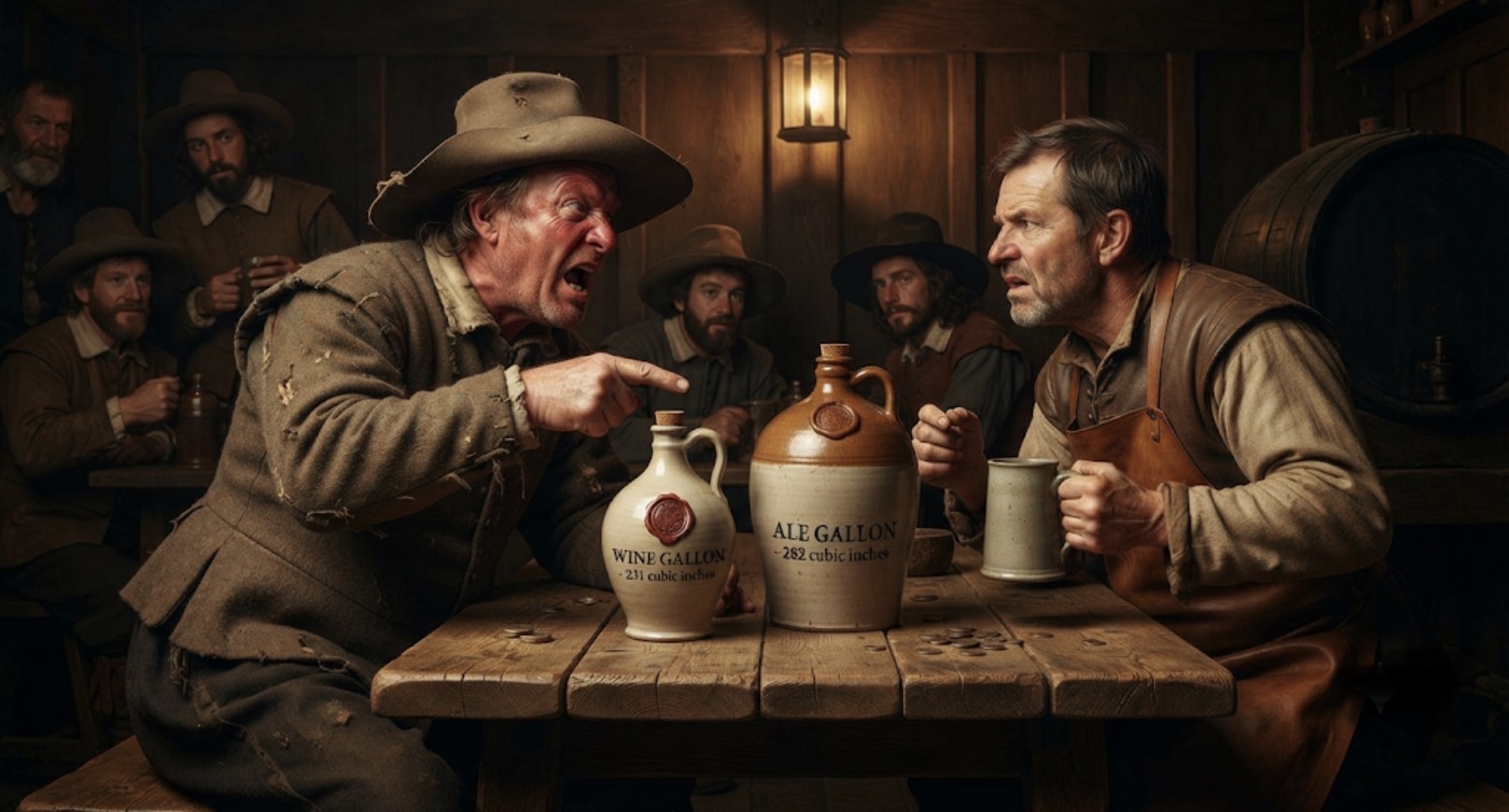
Imagine walking into a lively seventeenth-century tavern, slamming your coins on the counter, and demanding a pint. Sounds simple enough, right? But depending on whether you ordered a glass of imported French wine or a hearty mug of local ale, you might actually be participating in two completely different systems of mathematical measurement.
Before the Imperial Unification Act of 1824 finally forced everyone onto the same page, historical Britain treated liquid refreshment with a glorious, bureaucratic level of chaos. Two different-sized gallons ruled the realm, sparking centuries of tavern arguments, customs disputes, and legislative headaches.
The Queen Anne Wine Gallon: The American Time Capsule
If you prefer your history with a touch of international footprint, look no further than the Queen Anne Wine Gallon (1707). Statutorily enacted under Queen Anne to resolve messy maritime customs disputes, this unit fixed the wine gallon at precisely 231 cubic inches.
While Britain eventually phased it out, this exact historic volume crossed the Atlantic Ocean and became embedded in global history as the standard US fluid gallon used today. Every time you fill up a car or measure liquid in the United States, you are inadvertently interacting with Queen Anne's eighteenth-century customs decree!
The Historical Ale Gallon: The Working Class Champion
While luxury wines enjoyed a sleek, compact measure, malt liquor was treated as a fundamental daily necessity. The Historical Ale Gallon was defined at a much more generous 282 cubic inches.
Originating in the Tudor era, this larger volume was designed to ensure that ordinary working people received a substantially bigger, more forgiving pour of beer per penny than wealthy merchants buying imported wine. In short: the government actively engineered beer to have a better volume-to-price ratio for the masses.
Cask Chaos: From Rundlets to Oil Barrels
When merchants needed to move these liquids in bulk, they relied on a colourful vocabulary of traditional casks that scaled up the madness:
The Rundlet: A small historical British wine cask holding precisely 18 Queen Anne wine gallons, heavily favoured by early vintners and spirits merchants moving premium fortified wines across the rugged British Isles.
The Tierce: A traditional wine cask holding exactly 42 Queen Anne wine gallons. Its distribution geometry proved so perfectly balanced for physical transport and rolling across ship decks that centuries later, it was adopted as the standard global volume for a modern barrel of oil.
The Liquid Logic of History
History is rarely a straight line—it is usually shaped by taxes, thirst, and the stubborn refusal of different industries to use the same ruler. The next time you pour a drink, take a moment to be thankful you don't have to check whether your local tavern master is using an ale gallon or a wine gallon!