
Stand on a Cumbrian hillside in about 1850 and listen to a shepherd count his flock, and you will not hear English.
You will hear yan, tan, tethera, methera, pimp. And if you happen to speak Welsh, you will find that unnervingly familiar, because the Welsh for one to five is un, dau, tri, pedwar, pump.
That is not a coincidence, and it is not a borrowing. It is a survival.
The Language That Would Not Leave
Before the Romans came, the people of this island spoke Brythonic, a Celtic language. Then came four centuries of Latin administration, then the Anglo-Saxons, then the Norse, then the Normans. Each wave pushed the older language further west, until it survived as Welsh, Cornish and Breton and vanished from England altogether.
Except it did not entirely vanish. It held on in one improbable place: the counting of sheep.
The reason is almost comically practical. Language shifts where language matters — in courts, markets, churches and deeds. A man alone on a fell, moving his lips as animals file past him, is not participating in any of that. Nobody was checking. The sheep had no opinion. So the numbers a shepherd's grandfather had used were the numbers he used, and the chain held for something like fifteen hundred years after the surrounding language had been replaced twice over.
A note on the evidence: The Celtic derivation is not seriously disputed — the correspondence with Welsh, Cornish and Breton numerals is far too close for chance. The specific regional word lists are shakier. Almost all were written down by Victorian antiquarians and dialect enthusiasts, some of whom were more enthusiastic than rigorous, and a few variants may be reconstructions or simply whatever one obliging old shepherd said on one particular afternoon. Take the pattern as solid and any individual list as a snapshot.
Why It Stops at Twenty
The counts run to twenty and then start again: yan, tan, tethera, methera, pimp, and onward through compounds — yan-a-dick, tan-a-dick — to bumfit at fifteen and jiggit at twenty.
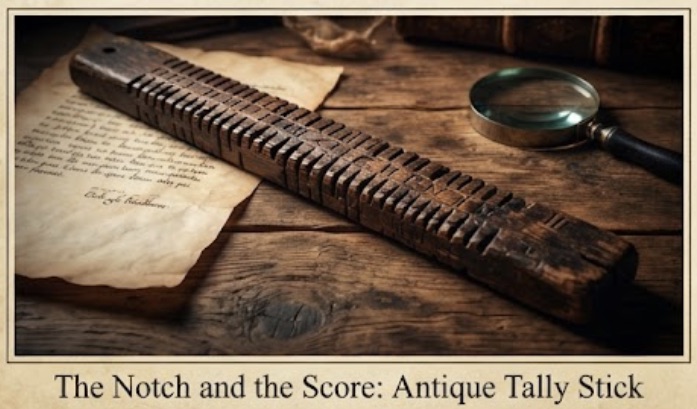
Twenty is not arbitrary. It is roughly the number of moving animals a person can hold in their head before losing the thread. At twenty, the shepherd cut a notch in his crook or shifted a pebble from one pocket to the other, and began again at yan.
The notches were the record. And the notches were called scores.
That word has travelled a long way. We keep score at cricket, settle old scores, score a goal and read a musical score, and every one of those senses traces back to a cut mark standing in for a count. Lincoln's "four score and seven years ago" is not poetry so much as the ordinary accounting language of his day. The English exchequer was still using notched tally sticks until 1826 — and burned so many of them in 1834 that the fire destroyed the Houses of Parliament, taking the national standard yard with it.
Then Somebody Had to Weigh the Wool
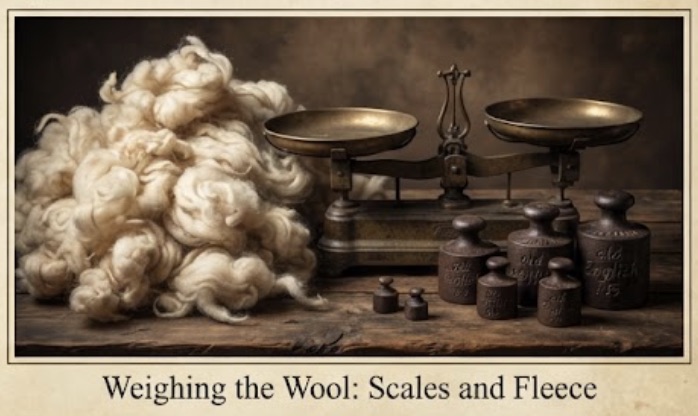
Counting the flock was the beginning. The animals existed to grow wool, and wool was the engine of medieval English wealth — the commodity that funded wars, built churches and gave the country its first genuinely international trade.
So the wool needed weighing, and here the system does something rather elegant.
The smallest unit of the wool trade is the clove: seven pounds. That figure looks arbitrary until you learn what it represents. Seven pounds is, roughly, the fleece of one medieval sheep.
Everything above it is a multiple of that:
- Clove — 7 lb, about one fleece
- Stone — 14 lb, two fleeces
- Tod — 28 lb, four
- Wey — 182 lb, twenty-six
- Pack — 364 lb, fifty-two
- Last — 4,368 lb, some six hundred and twenty-four
Which means the entire hierarchy is a way of counting sheep without counting sheep. A merchant quoting a price per pack was, without thinking about it, quoting a price for the annual yield of roughly fifty-two animals.
The Crown Was Watching
None of this was left to custom for long, because wool was taxable and taxation requires agreement.
Under the Statute of the Staple of 1354, certain goods could be exported only through designated towns, where they were weighed, graded and taxed under royal supervision. Wool was the principal one. Export duty on it funded a substantial share of the Hundred Years War, which is a striking thought: the English campaigns in France were paid for, in large part, by sheep.
The staple for wool sat at Calais for well over a century, making an English possession in France a central institution of English commerce. And the word itself has softened beyond recognition — a "staple good" now means something basic and reliably available, which is a considerable downgrade from a tightly policed royal monopoly.
The Lord Chancellor still sits on the Woolsack in the House of Lords. It is not decoration. It is a reminder, placed there in the fourteenth century, of where the money came from.
What the Sheep Left Behind
Pull the threads together and the scale of it is odd to contemplate.
A counting system in a language England otherwise forgot. A word — score — that we still use half a dozen ways without knowing it means a notch. A weight system whose base unit is one animal's annual growth. And a tax regime that shaped English foreign policy for a century and a half.
We tend to think of measurement as something imposed from above: a king's arm, a brass bar in a vault, a committee in Paris. A good deal of it worked the other way. It grew from underneath, out of what people actually had to do — and what a great many people in England actually had to do, for a very long time, was look after sheep.
Yan, tan, tethera. Fifteen centuries, and still counting.