Three Hundred Fish on Your Back: The Measures of the Cornish Pilchard Trade

Here is a problem. You have twenty thousand pilchards in a net in the shallows, a curing cellar four hundred yards up a steep street, no harbour, no crane, no cart that can manage the gradient, and about six hours before the fish start to turn.
How do you measure them? And, more pressingly, how do you carry them?
The answer the Cornish arrived at is one of the most complete measurement systems in British history, and almost nobody has heard of it. It ran from a handful of fish to a cask bound for Genoa, and every unit in it was also a container, because in this trade there was no distinction between measuring the fish and moving them.
The Basket That Became a Number
Start with the maund. A stout two-handled wicker basket holding three hundreds of pilchards — around 360 fish, fifty to fifty-five pounds.
Why that size? Because fifty-five pounds was reckoned the most one person could reasonably carry. Which turned out to be optimistic: a full maund really needed two people, since the load sat out in front and pulled the carrier steadily off balance. Anyone who has attempted to move a full laundry basket across a room will recognise the physics.
Ten maunds made a hogshead. So the basket was not merely a basket — it was a unit of account. A cellar recording its intake in maunds was recording it in tenths of an export cask, and everybody in the chain knew exactly where they stood.
A word that travelled: The maund shares its name with the Indian maund, a weight that took wildly different values in Bengal, Bombay and Madras and caused East India Company clerks no end of grief. The two are probably related at some distant root, which means a Cornish fish basket and a subcontinental trade weight are, in a manner of speaking, cousins.
Then Somebody Noticed the Hill
The maund works on a quay. West Cornwall had almost no quays.
Fish were landed on open foreshore, and getting them to the cellars meant scrambling across wet weed-covered rock with a heavy basket held out in front of you. This is not a good idea. It is barely even a survivable idea.
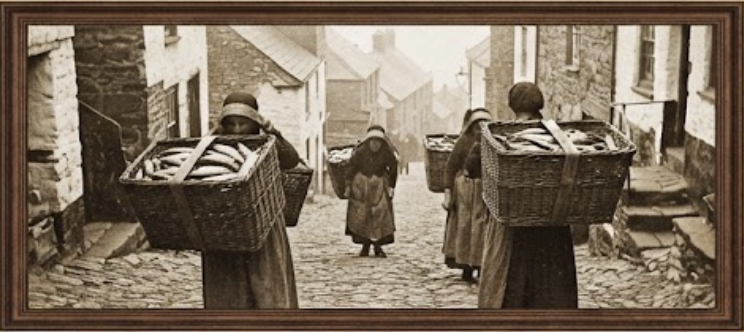
So the trade produced the cowel: the same three hundreds of fish, in a rectangular trough-shaped basket with squared ends, carried on the back and steadied by a plaited band across the forehead. Both hands free. Weight over the spine rather than swinging in front of you.
Many of the carriers were women. The carrier stood with her back to the boat, was loaded at gunwale height, and then walked up through the streets of Newlyn or Mousehole with fifty-odd pounds of fish and a strap across her brow.
Spelled cawal, cowal or cowl, depending on which village you asked. Consistency was never a strong feature of this trade.
The Two-Man Solution
If the cowel solved the problem of one person carrying a load, the gurry solved the problem of carrying twice as much.
A gurry was a large rectangular box on squat legs, with long poles fixed to each side. Two men took the poles and bore it stretcher-fashion between them, six hundreds of fish at a time — about 720 pilchards. The legs meant it could be set down on the beach without tipping its contents into the sand.
It was used chiefly at St Ives, and it lasted long enough to be photographed, turning up in a good many images of the fish market alongside stacked maunds.
A Thousand Means Twelve Hundred
Now the counting, which is where it gets properly British.
Pilchards were counted in hundreds. Not hundreds of a hundred — long hundreds of 120, an old Germanic convention that survived in the fish, timber and nail trades long after everyone else had settled on the number a hundred obviously means.
Ten of those made a thousand. Which is 1,200 fish.
Three thousands filled a hogshead: nominally 3,600 pilchards, in practice anywhere between 2,500 and 4,500 depending on the size of the run. So a cask sold as containing three thousand fish might hold four and a half, and this was not fraud but simply how the trade worked.
The Handful You Threw In
Then there is the cast, which began as exactly what the word suggests: a handful of fish thrown aside as make-weight.
Buyers wanted a margin against fish that turned out undersized or broken. Rather than inspect every catch, the trade simply agreed on a number of extra fish per hundred. Five for pilchards. Twelve for mackerel at Newlyn.
People took this seriously. At Kinsale in April 1873, buyers pushed for a further sixpence in the pound discount. The fishermen refused, arguing they already gave two casts in every 120 and that was quite enough. The dispute ran three days, cost one man his life, and ended with the established terms restored.
Somewhere earlier in history the cast and the warp appear to have meant the same thing. When and why they diverged is not recorded, which is a recurring theme once you start looking into any of this.
And Then There Is the Pot
My favourite unit in the entire archive, and it is my favourite because it does not work.
Recorded at Folkestone in the 1830s, alongside the pad: three pots make a pad. Two pots make a half-pad.
Read that twice. It cannot both be true. Three of something cannot equal one whole while two of the same thing equal one half.
No contemporary source explains it. The likeliest reading is that a pot was a container of roughly known size rather than a defined measure, and the two relationships served different purposes in the same market — but nobody wrote that down, because nobody in Folkestone in 1832 anticipated being questioned about it.
It is a useful corrective. Customary measures were working conventions, not mathematical systems, and the people using them were rarely troubled by inconsistencies that keep modern readers awake.
Where the Fish Went
The whole apparatus existed to fill hogsheads, and the hogsheads went to Catholic Europe.
Salted pilchards were a staple of the fasting calendar in Italy and Spain, which meant a Protestant fishing village in Cornwall spent three centuries feeding Mediterranean religious observance. The trade was substantial enough that the cellars pressed the fish under weight, and the oil squeezed out was itself a saleable product.
The old Cornish toast has it exactly right:
"Here's health to the Pope, and may he repent, and lengthen by six months the term of his Lent. It's always declared betwixt the two poles, there's nothing like pilchards for saving of souls."
What It Adds Up To
Every unit in this system is a physical object. The maund is a basket. The cowel is a basket you can climb rocks with. The gurry is a box two men can carry. The hundred is 120 because it always was. The cast is a handful. The pot makes no sense at all.
None of it was designed. It accumulated, one practical problem at a time, until a village could move twenty thousand fish from a net to a cask and everyone agreed on what had happened.
That is what a measurement system actually is, most of the time. Not a committee's decision — just what worked, repeated until it hardened.