The Oxgang: The Unit That Depended on Your Neighbours' Livestock
Most units describe a thing. A pound is a weight, a furlong is a distance, a pint is a quantity of beer. The oxgang is stranger than that, because it describes a share.
To know how much land an oxgang was, you first had to know how many animals your household had contributed to a plough team that belonged to nobody in particular. It is a measurement that only makes sense once you understand who your neighbours were.
The Problem With Medieval Ploughing
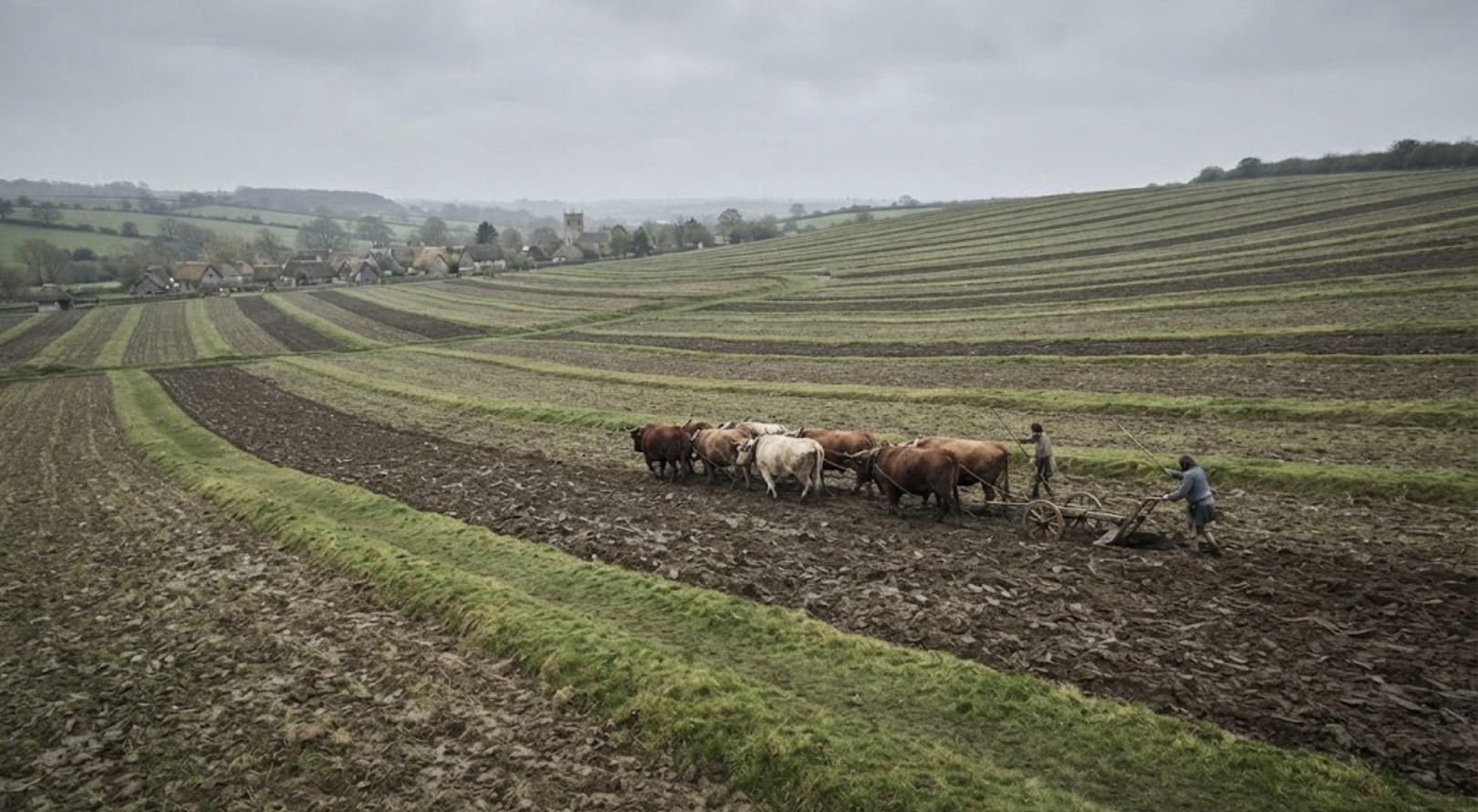
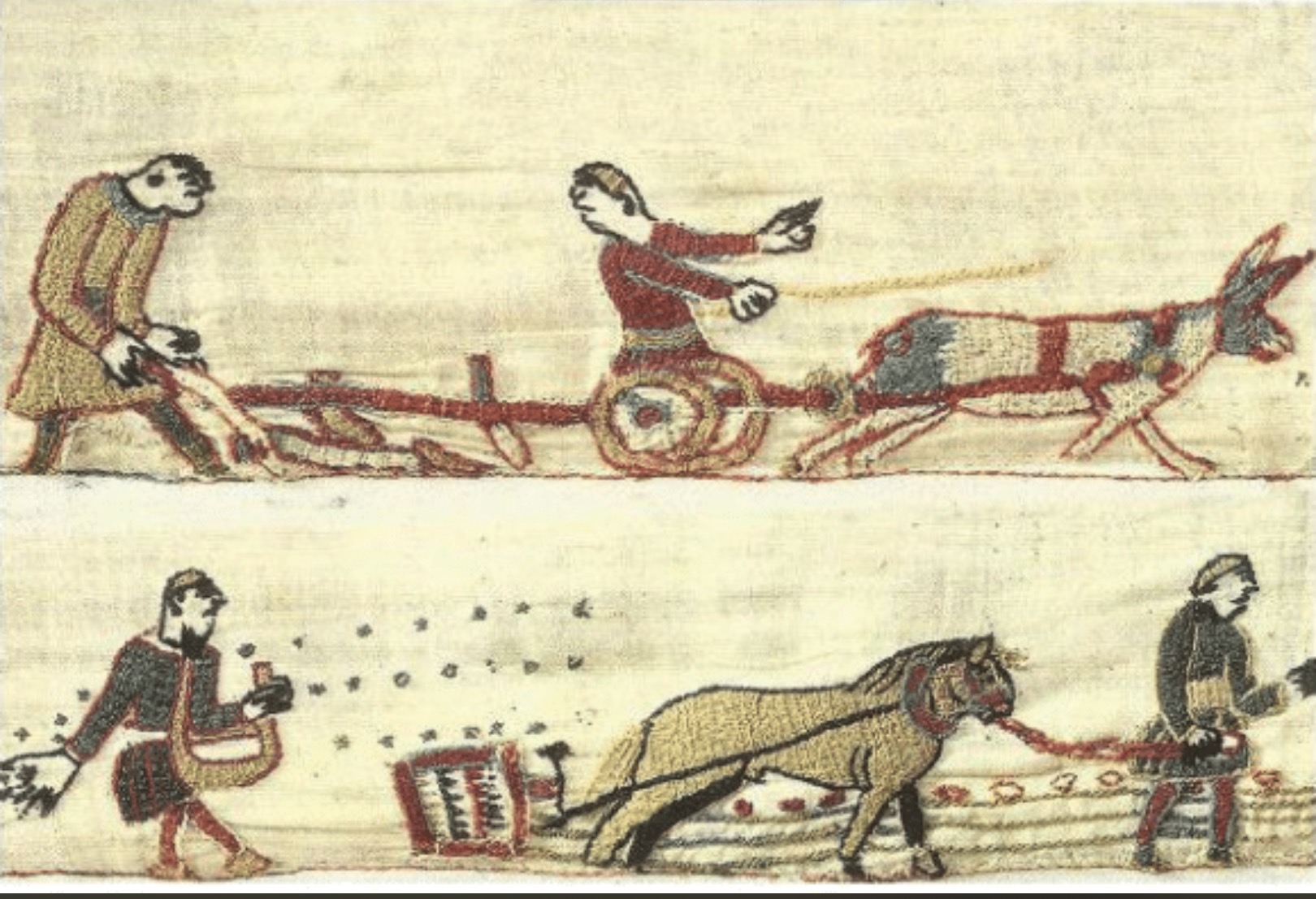
The heavy clay soils across much of England could not be worked with a light scratch plough. They needed the mouldboard plough: a substantial wheeled implement with a coulter to cut the sod, a share to slice it horizontally, and a curved board to turn it over completely. It buried weeds, aerated the soil and opened drainage furrows. It also required enormous pulling power.
The standard team was eight oxen. Almost nobody owned eight oxen.
An ox was a serious capital asset, representing years of feed, training and risk. A typical peasant household might own one, perhaps two. A prosperous one might manage four. Eight was the province of the manor itself, and the manor's plough was busy with the manor's land. So villages did what people do when a necessary tool exceeds any individual's means. They pooled.
One Ox, One Oxgang
Households contributed what animals they had to a communal team. The team worked its way through the village's arable land, and the resulting ploughed acreage was divided among the contributors in proportion to what each had put in.
Contribute one ox to an eight-ox team, and you received one eighth of what that team could plough in a season. That eighth was your oxgang: roughly fifteen acres, though it varied considerably with soil, terrain and local custom.
Eight oxgangs made a carucate, the land a full team could work in a year. The Latin records call it a carucata after caruca, the plough itself, and the oxgang appears there as a bovata, from bos, an ox. English kept both vocabularies: bovate and oxgang mean precisely the same thing.
Why This Was Not Merely Quaint
The arrangement had consequences that ran well beyond agriculture.
It made ploughing a negotiation. A household that lost an ox to disease or debt did not simply farm less efficiently; it farmed less land, permanently, until it could replace the animal. Fortunes within a village could turn on the health of a single beast.
It bound neighbours together whether they liked one another or not. You could not opt out of the shared team without opting out of arable farming altogether, so village disputes had to be resolved rather than merely endured. The plough had to go out regardless.
And it made land legible to the Crown. When William's commissioners came through in 1086 compiling the Domesday Book, they wanted to know what each holding could produce. Asking how many carucates a manor held was more useful than asking its area, because it captured productive capacity directly. Poor land needed more acres to make a carucate; good land needed fewer. The unit absorbed the variation automatically.
Two Systems, One Country
Here the Danes complicate matters, as the Danes tend to.
In Wessex, Mercia and the south, land was assessed in hides: notionally enough to support one household, roughly 120 acres, subdivided into four virgates of about thirty acres each. In the northern and eastern counties reshaped by Danish settlement, the same job was done by the carucate and its eight oxgangs.
The two systems describe almost exactly the same extent of land. But they were reckoned from different starting points: the hide from what a household needed, the carucate from what a plough team could achieve.
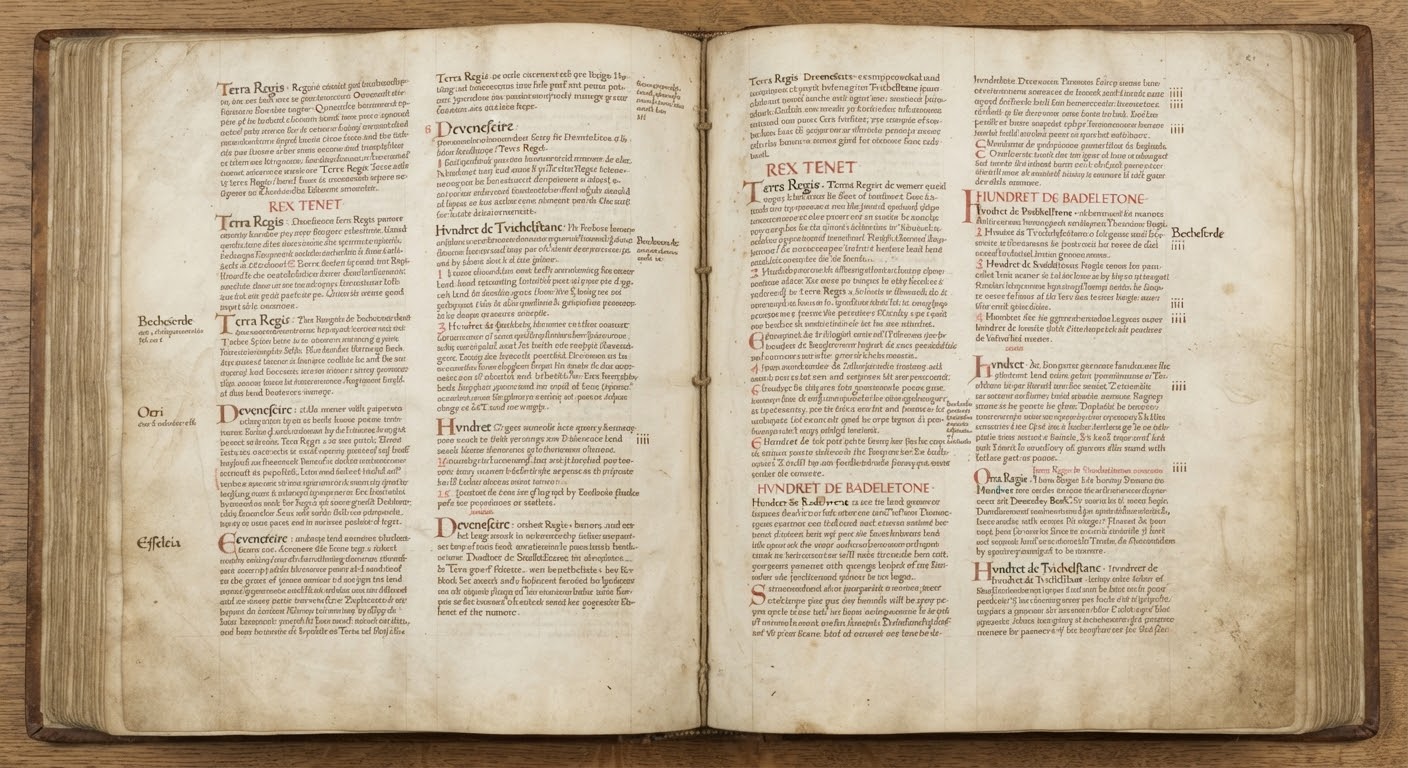
Domesday Fun Fact: The commissioners recorded each region in its own vocabulary rather than imposing a single standard. The result is that a Norman survey conducted in Latin quietly documents where Viking administrative practice had taken hold two centuries earlier. Run a finger down the Domesday entries and you can trace the boundary of the Danelaw by which unit the clerks reached for.
Where the Oxgang Went
The open-field system that made shared ploughing necessary was dismantled over centuries by enclosure. Individual holdings replaced scattered strips, heavy horses replaced oxen, and eventually machinery replaced both. The reason for the unit disappeared.
The unit itself proved more durable. Oxgangs appear in Scottish and northern English property records well into the nineteenth century, long after anyone had pooled a team. Field names preserve it in places, as does the occasional boundary still following a division agreed when the relevant question was how many animals the household on the next croft could spare.
A Measurement Worth Remembering
We are used to units that pretend to be objective. A metre is a metre regardless of who holds the ruler, and that universality is precisely what makes modern measurement useful.
The oxgang made no such claim. It measured land in terms of labour, labour in terms of livestock, and livestock in terms of what a household could afford. It was contingent, local and social all the way down.
That is not a defect. For the purpose it served, dividing shared effort fairly among people who had to keep working together afterwards, a unit that encoded the arrangement was better than one that ignored it. The oxgang told you not just how much land you had, but why you had it.