Tracking time in British history was less about the precise ticking of a digital clock and more about the rhythms of agriculture, the turning of the seasons, and the strict rules of maritime survival. Before the UK standardised time across the nation in the 19th century to accommodate the expansion of the railways, timekeeping was deeply localised and woven into the fabric of daily ritual.
1. The Agricultural & Legal Calendar: Traditional English Quarter Days
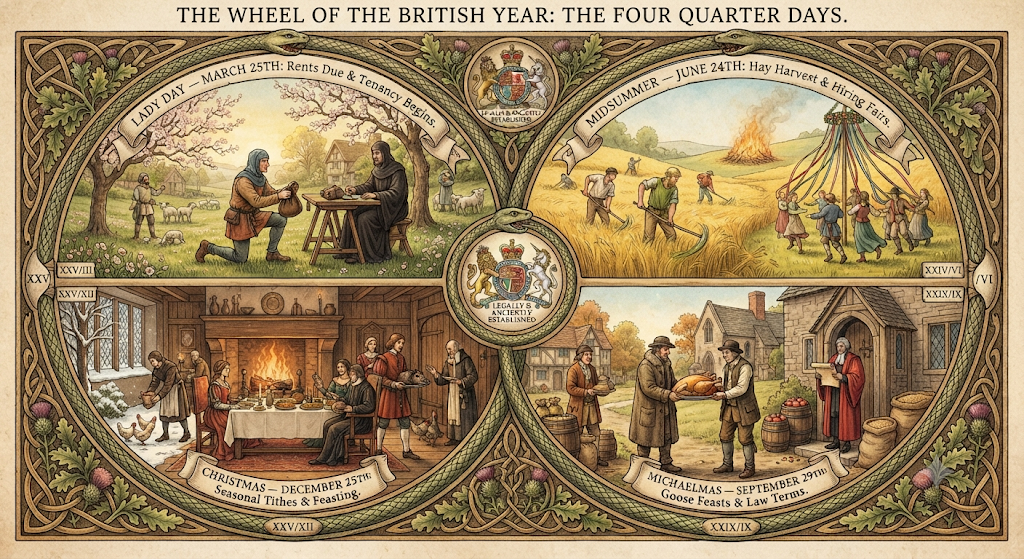
Long before the standard calendar year dictated business, the English and Scottish legal and economic systems revolved around Quarter Days. These four specific religious festivals fell roughly three months apart, marking the dates when agricultural tenancies began, land rents were due, and school terms commenced:
- Michaelmas (29th September): Marked the end of the harvest and the beginning of the new farming year.
- Lady Day (25th March): Historically the official New Year's Day in England until 1752.
- Midsummer / St. John's Day (24th June): The longest day of the year, vital for calculating crop yields.
- Christmas (25th December): The winter solstice turn and mid-winter settlement period.
Note: Scotland utilised a distinct system of Term Days (Candlemas, Whitsunday, Lammas, and Martinmas) to serve the same economic purpose.
2. The Rhythm of the Waves: British Maritime Dog-Watches
As a global naval superpower, Britain's Royal Navy developed a highly specific way of dividing the 24-hour day into Watches. Sailors divided the day into six 4-hour blocks. However, to prevent the same crew from being stuck with the gruelling midnight shift, the British introduced the Dog-Watches.
The 4-hour evening block (4:00 PM – 8:00 PM) was split in half into the "First Dog-Watch" (2 hours) and the "Last Dog-Watch" (2 hours). This irregular time unit ensured a daily rotation of shifts, guaranteeing fair treatment for the crew.
3. Surviving Imperial Phrases: The Sennight, The Fortnight, and The Score
Some historical time units were so ingrained in British culture that they survived long after other Imperial measurements faded:
- The Sennight: Derived from the Old English seofon niht, meaning "seven nights." While rarely used in modern conversation, it was the standard way of measuring a week in historical texts, serving as the direct partner to the fortnight.
- The Fortnight: Derived from the Old English fēowertīene niht ("fourteen nights"). It remains a standard unit for bi-weekly wage payments, television scheduling, and holiday bookings across the UK today.
- A Score of Years: Meaning twenty, this was the standard historical unit for measuring human generations and long eras of time, frequently appearing in historical legal documents and literature.