The Yard: The Royal Anatomy That Standardised Global Trade
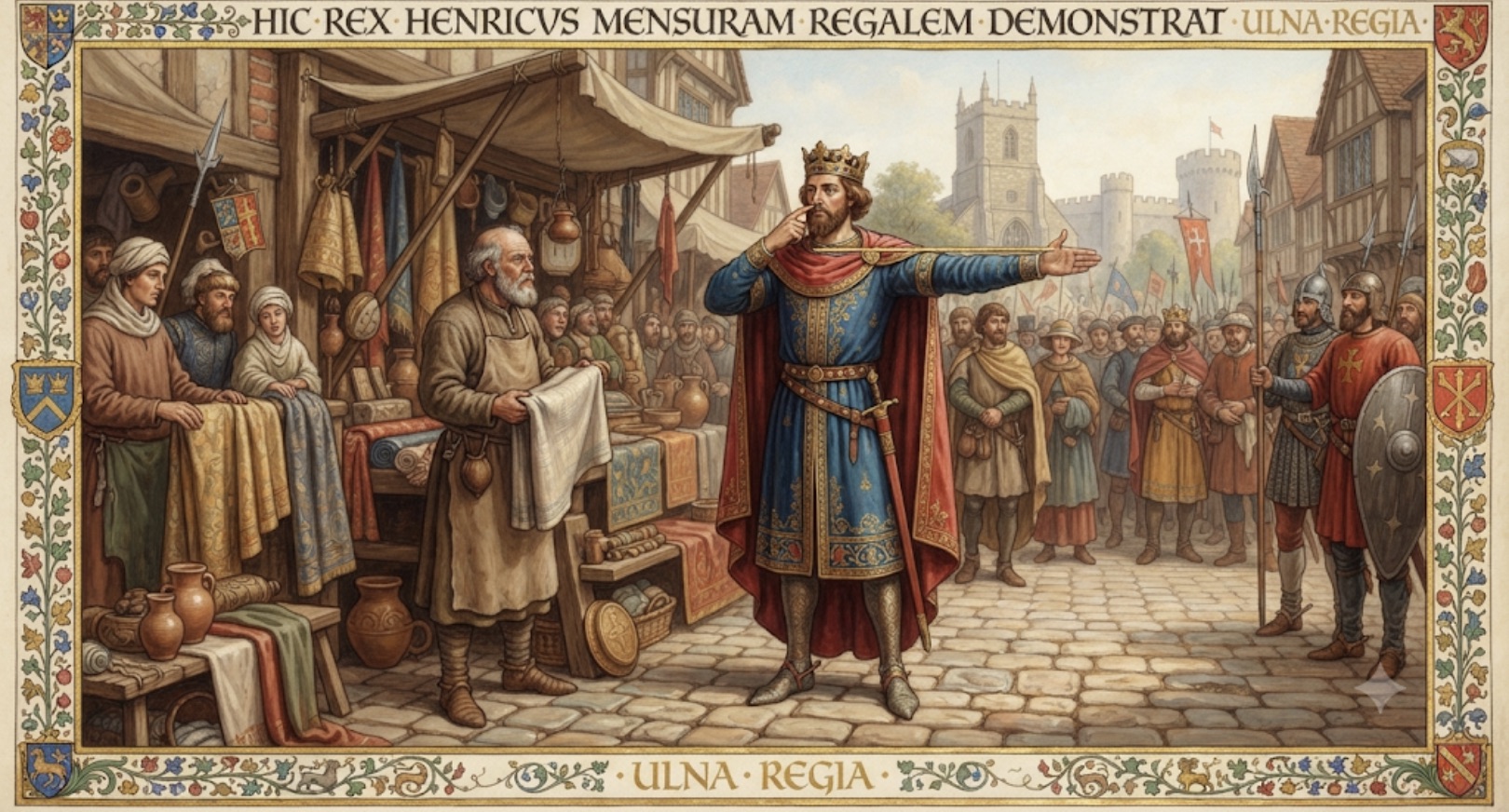
We see the Yard everywhere: on football fields, fabric shops, and construction sites. It is the steady backbone of the Imperial length system, sitting comfortably between the small foot and the long mile. Yet, for centuries, the yard was a unit in absolute chaos, floating around the whims of monarchs and the literal length of royal clothing.
The Legend of the Royal Nose
The word "yard" derives from the Old English gyrd, meaning a twig, rod, or measuring stick. Because early merchants needed a quick way to measure cloth, they often measured from the centre of their chin to the tip of their outstretched thumb—a practice that led to endless disputes. According to folklore, King Henry I settled these arguments by decreeing that a yard should be the exact distance from the tip of his own royal nose to the thumb of his outstretched hand.
The Tragedy of the Fire of 1834
By the Victorian era, Britain needed a standard more reliable than a legendary king's anatomy. In 1824, Parliament created the Imperial Standard Yard—a solid brass bar with two gold pins precisely 36 inches apart—and locked it in the Houses of Parliament. In 1834, a massive fire destroyed the building and melted the standard bar into a useless puddle.
Victorian Fun Fact: To recreate the lost standard, Victorian scientists had to gather older copies of the bar and use advanced thermal mathematics to forge a brand-new, highly accurate version out of a special alloy known as "Baily's Metal."
The Modern Alignment
The Victorian obsession with precision paid off; their recreated yard bar was so accurate that when Britain officially coordinated with international scientists in 1959, the yard was locked to the metric system at exactly 0.9144 metres. Today, it remains a testament to the transition from arbitrary royal decrees to the rigorous demands of global industrial science.