The Poetic Price of Maturation: Understanding the Angel's Share and the Devil's Cut

For every bottle of fine whisky or bourbon, there is a hidden story of loss and transformation. As spirits rest in their oak cradles, they aren't just sitting still—they are breathing, expanding, and contracting with the rhythm of the seasons. This maturation process gives birth to two of the industry’s most evocative terms: the Angel’s Share and the Devil’s Cut.
What is the Angel’s Share?
The "Angel’s Share" is a whimsical term for the volume of spirit lost to evaporation. As whisky matures in porous wooden casks, the liquid interacts with the environment. Through the natural "breathing" of the barrel, a percentage of the spirit escapes into the atmosphere. Distillers often view this as a necessary sacrifice to the heavens—a tribute paid to the angels in exchange for the liquid's ethereal development and complexity.
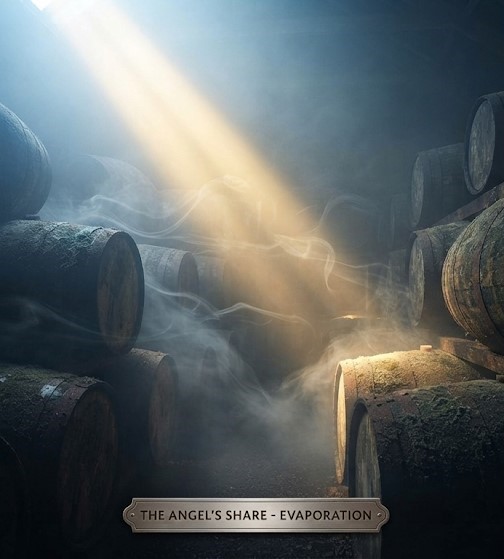
The Geography of Loss
The rate of this "heavenly tax" depends largely on the climate:
- Cooler Climates: In Scotland, Ireland, or Japan, where the climate is more temperate, producers typically lose about 2% of their volume annually.
- Warmer Climates: In regions like Kentucky, Tennessee, or even Taiwan, higher temperatures accelerate evaporation. In some tropical locations, the angels claim a "double-digit" share—sometimes as high as 12% per year.
The Devil’s Cut: Reclaiming the Lost Flavour
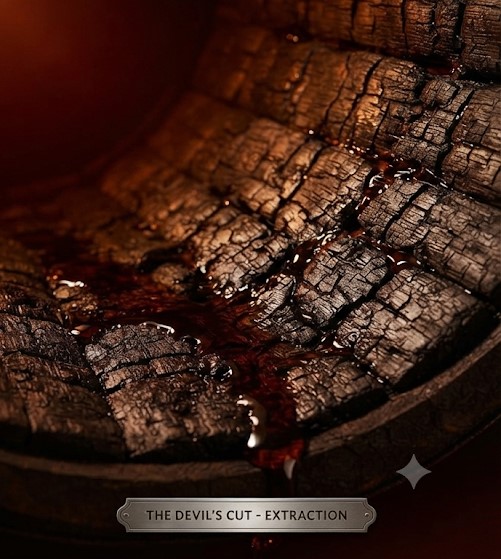
If the Angel’s Share is what escapes into the air, the "Devil’s Cut" is what remains trapped behind. Because oak is a porous material, a portion of the spirit is absorbed deep into the wood fibres of the barrel staves. While the angels take their share through the air, the "devil" claims his portion by pulling the spirit into the walls of the cask.
For years, this liquid was considered lost. However, modern innovation has found ways to reclaim it. By using specialised techniques—such as adding a small amount of water to the emptied cask and rotating it at high speeds—distillers can extract the spirit embedded in the wood. This recovered liquid is often intensely flavourful, carrying concentrated notes of the oak, char, and caramelised sugars that have been soaking into the staves throughout the maturation process.
Fun Facts: From Space to Cocktails
• Whisky in Space: To study how extreme environments affect maturation, Ardbeg sent whisky samples to the International Space Station in 2011. They later released "Ardbeg Galileo" to celebrate the experiment.
• Smoking the Devil: Some innovative cocktail bars now take the wood from barrels "soaked" with the Devil's Cut, shave it into chips, and use it to smoke cocktails. The result is a drink infused with toasted marshmallow and deep caramel notes directly from the barrel’s history.
Why It Matters for Your Glass
Understanding these phenomena helps us appreciate the true cost—and patience—behind a bottle of aged spirit. Whether it’s the 2% lost to the Scottish mists or the flavour trapped deep within the oak, these losses aren't just waste; they are the fundamental components of the complex, rich flavours we enjoy today.